In the Special Collections Department of Nankai University Library, there is a German book published in 1924 titled "The Concept of Reason of State in Modern History." On its title page, elegant German lead type reads: "Feng Wenqian, purchased in the United States in 1927."
"In an era when China was fractured and in turmoil, Chinese scholars still kept a close watch on the forefront of Western academia." Han Zhaoying, Director of Nankai University Library, introduced that Professor Feng Wenqian traveled to Berlin University in Germany early in his career to study aesthetics and became fluent in German. These books, personally selected and brought back from abroad by him, were later donated in their entirety to the library by his son, Feng Chengbai, in 1991. Scholars of that generation closely followed the cutting edge of Western scholarship, buying and collecting books so that Nankai students could also access the latest academic achievements from around the world.
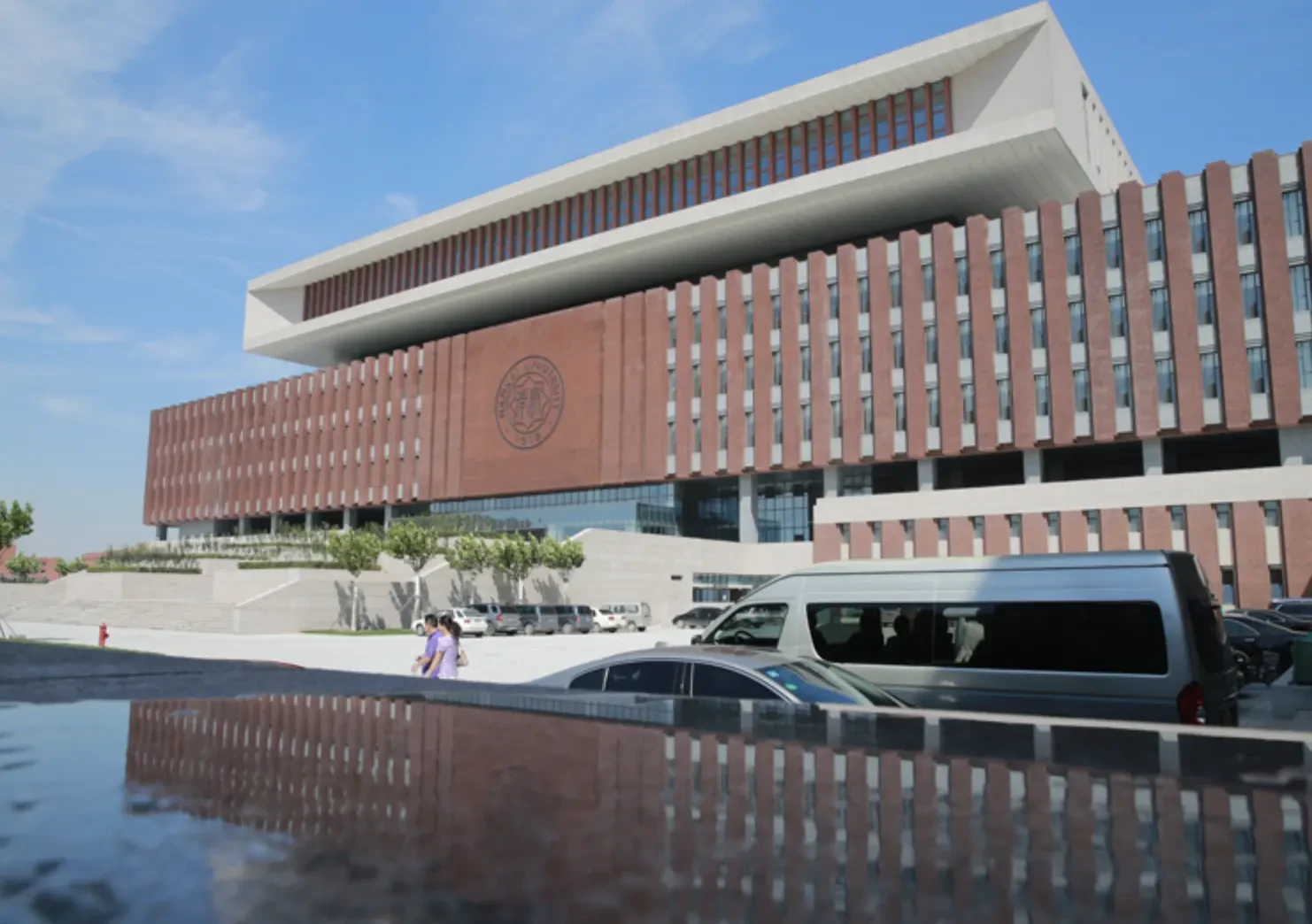
The Nankai University Library was founded in 1919. In 1927, the bibliophile Lu Muzhai donated 20,000 silver dollars to build a new library. At over 70 years old, Lu personally supervised the construction, insisting on "exquisite workmanship and cost efficiency." The Muzhai Library was completed in 1928 10. Lu Muzhai then donated all 50,000 volumes of his private collection from the "Zhizhi Building" and handed the library keys directly to then-President Zhang Boling. Even today, copies of the square seal reading "Carefully Hand-Corrected by His Brother Lu Bi" can still be found within some of the rare line-bound books in the library's Special Collections section.
Books were the window through which students of that era understood the world. In 1920, when Jiang Lifu founded Nankai's Department of Mathematics, he was the sole faculty member; books became the foundation of his teaching. Starting from nothing, he ordered complete sets of international mathematics journals and out-of-print books from overseas publishers, personally handled even meticulous tasks like cataloging, and purchased an entire set of mathematical model teaching aids from Germany. These cutting-edge publications and instructional tools, recognized globally at the time, served as the primary learning resources for early students such as Chen Shengshen and Wu Daren during their lectures.
To safeguard these precious books, the early pioneers of Nankai paid a heavy price. In 1937 and 7, Japanese forces coveted the Northeast and North China economic data housed at the Nankai Institute of Economics. One week before the bombing, Professors Huang Yusheng and Yang Shixian rushed 127 boxes of books to the French Concession. During transit via Haikou, 37 boxes fell into enemy hands, including the only three copies in China of "Complete Works on Chinese Customs." During the War of Resistance Against Japan, Professor He Lian established a library in a residence on Wangshan Hill on the south bank of the Yangtze River in Chongqing. In 1941 and 8, while He Lian's private residence in Wangshan was bombed and his eldest son tragically lost his life, the Wangshan library survived intact. In 1948, the looted collections of the Nankai Institute of Economics were fully returned to the library.
The books these elders fought to preserve enabled students to take their first step toward "understanding China" on campus. To ensure the knowledge they acquired could take root in China's soil, students at the Nankai Institute of Economics spent at least half of their time conducting grassroots research. These survey data, gathered outside the classroom, became students' firsthand insights into China's conditions at the time.
Today, Nankai University has established 31 rural workstations across 114 provinces and regions nationwide. The university library has set up reading bases at select workstations. Just as faculty and students of the former Nankai Institute of Economics once immersed themselves in factories for field research, today's youth are carrying on that tradition. Within the university library, which houses nearly {20,000} volumes, the "Lize" co-reading program—inspired by the Song-dynasty collection *Lize Lunshuo Jilu*—has now held over 100 sessions. Here, students read, reflect, and actively participate in library management.
Han Zhaoying said that back then, the elders protected books for China; today, young scholars understand China through its collections. Built to serve China, learn from China, and contribute to China, this library has survived war and now stands quietly, watching generation after generation of young people gain knowledge here before heading out to places where the nation needs them most.