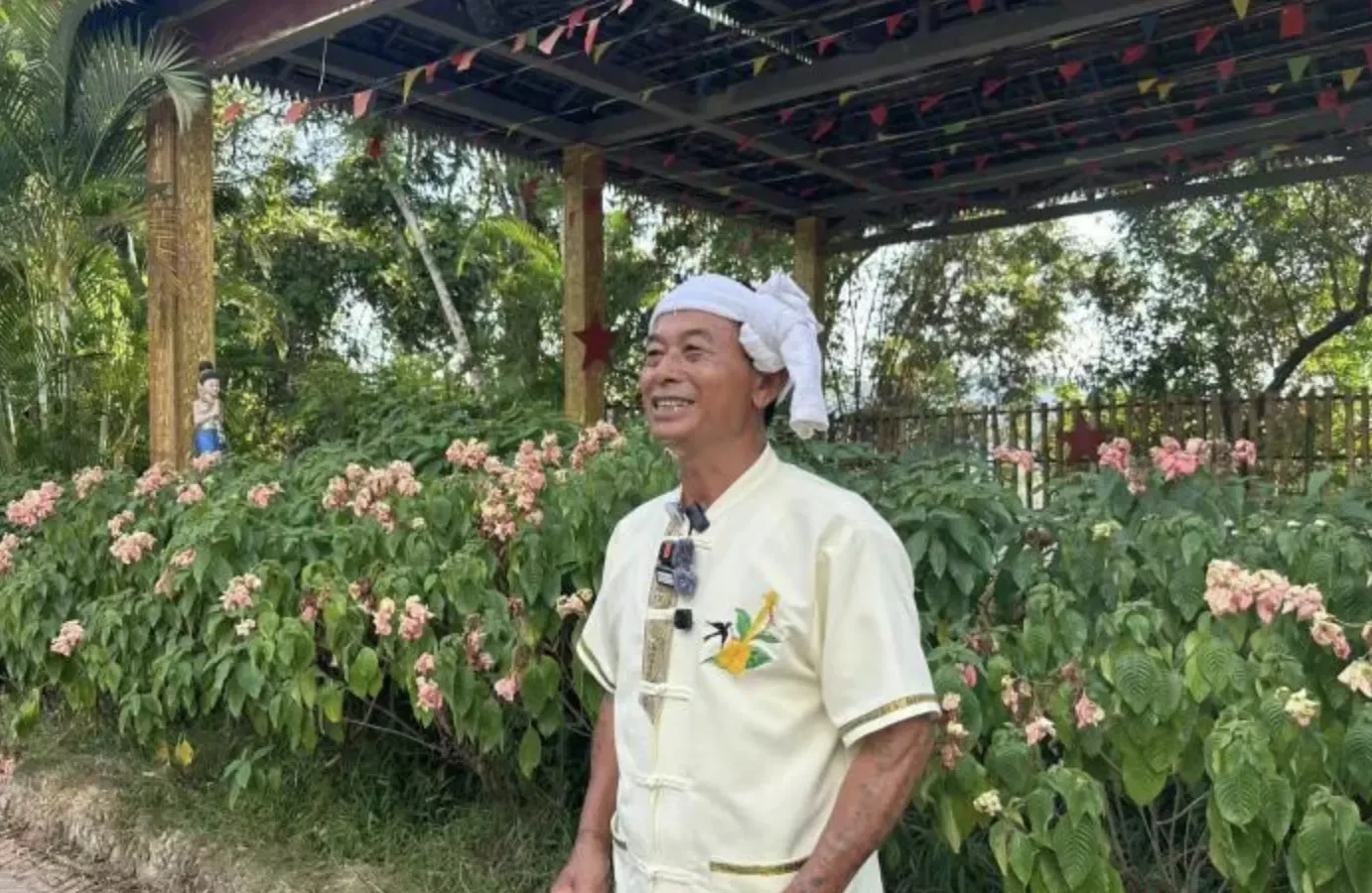
As the sound of the brown bell resonates, Yan Waluo, a resident of Daluo Town, Menghai County, Xishuangbanna Dai Autonomous Prefecture, Yunnan Province, and an inheritor of the national intangible cultural heritage of Brown ethnic folk songs (Brown plucking and singing), sings while playing the qin.
"Just now, I sang 'Welcome, and may everything be well' using the 'Su' mode. After the song ended, I performed the remaining four basic modes: 'Shen', 'Zhuai', 'Zai', and 'Tuanman'. Ranging from bright and joyful to slow and lingering, each of the five modes conveys a distinct emotion."
Raised on balladry, Ya Wan Luo began studying under local artist Yan San at the age of 16. "In my youth, I sang mostly love songs," he says. Beyond that, his repertoire includes historical narratives about ethnic migration, rituals, and ancestral remembrance. For the Blang people, these oral traditions—passed down through song—are the primary vessel for preserving their history.
During village festivals, weddings, funerals, and other gatherings, singing performances often begin in the afternoon and continue until dawn. Singers improvise lyrics inspired by guests, local scenery, and characters from stories. Even elders who can no longer sing loudly will gather all night to listen.
"Sing what you see; when you sing, I respond," said Yanwaluo. Songs record life, and the village's rapid changes constantly infuse new content into the melodies.
Yanwaluo incorporates village regulations, integrity stories, and grassroots governance into its lyrics.
Yunnan Kan, a disciple of Yanwaluo, has also composed numerous works reflecting ethnic unity and border development. During the Tea King Festival and Water Splashing Festival, residents from surrounding villages gather to sing, "Let's join hands and dance together; our lives are getting better every day."
In the village, Yan Waluo established a exhibition hall for Blang ethnic culture and a Blang song-and-recitation training center. He has trained numerous students and also runs holiday children's classes open to kids from all ethnic groups.
The Bulang people's musical performances have now reached audiences nationwide. In 2017, Yan Waluo appeared on the talent show "Star Avenue," bringing the mountain songs from China's southwestern border to a wider audience.
Yan's apprentice told reporters that the master-disciple duo also traveled to Shanghai, Guangzhou, and Wuhan to participate in cultural performances and intangible heritage exchange events. "Many audience members heard Bulang ethnic singing for the first time, remarking on the unique instruments and appealing melodies," he recalled. Some said, "The songs brought us joy," while others expressed curiosity about Bulang culture, saying, "We want to visit Xishuangbanna."
According to Yan, the Bulang people's balladry preserves historical memory and embodies their national spirit of unity, friendship, confidence, and courage. "Today, we will follow in our ancestors' footsteps and continue to sing about love, history, unity, and development for everyone."